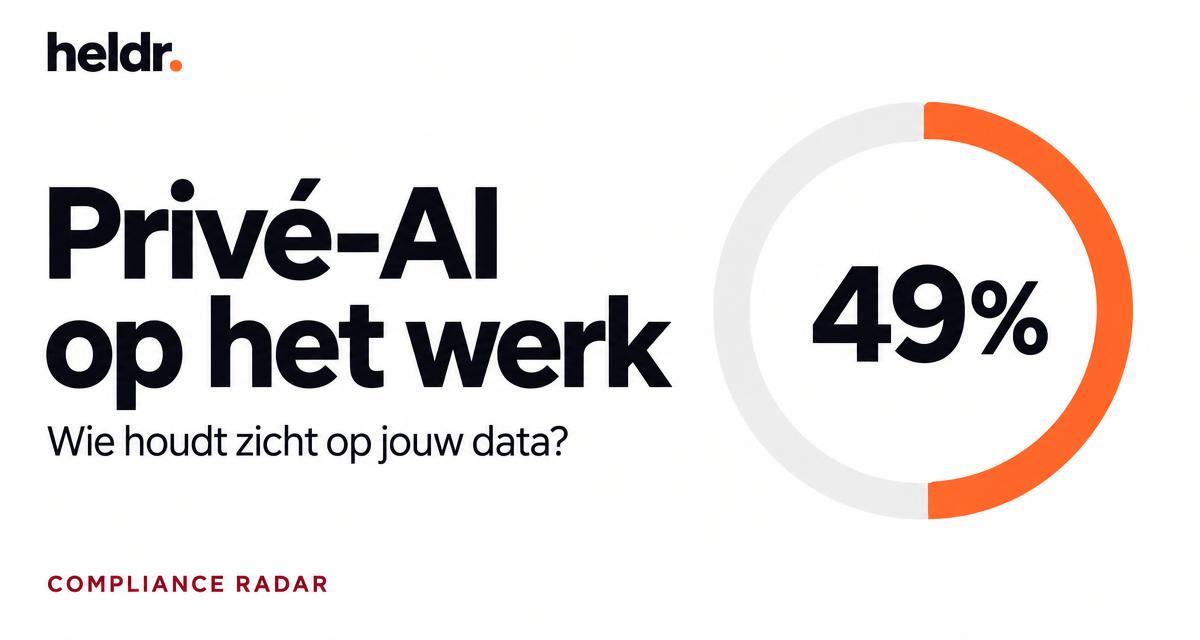
49% of surveyed employees use private AI for work. What is your business exposed to?
Almost half of employees in the Alert Online 2026 survey use private AI accounts for work. For SMBs, that is not an IT detail. It directly affects privacy, AI literacy and information security.
In brief
- 49% of surveyed employees use private AI accounts or apps for work; 35% use AI without their employer's permission or knowledge.
- Only 39% know which AI tools their organisation allows.
- A ban alone is not enough. Make approved tools, data boundaries and a safe working environment visible.
What the research actually says
The Cybersecurity Behaviour Survey Alert Online 2026 surveyed 378 employees. Of those respondents, 49% sometimes, often or always use private AI accounts or apps for work. And 35% use AI tools without their employer's permission or knowledge. Those are survey findings, not a measurement of your own workforce.
The underlying problem is visibility: only 39% know which AI tools are allowed, and the same proportion know the AI policy. A policy can exist on paper while employees still have no idea what they may paste into a prompt on a busy working day.
For a business owner, the useful question is not whether your company matches that percentage. It is whether you can name the tools your team uses, the data going into them and the person responsible for each use case.
Shadow AI rarely starts with bad intentions
Picture an account manager who needs to summarise a customer call before the next meeting. A private chatbot is already open. They paste the transcript, get a useful summary and move on. The task is finished, but customer names, contact details or commercial agreements may now be outside the organisation's controlled environment.
The same happens with job applications, payroll spreadsheets and internal proposals. The employee wants to work faster. The risk comes from a missing safe route, unclear rules and settings nobody has checked. A private account may also keep conversation history or have different retention and training settings from a contracted business service.
Why this touches three frameworks at once
GDPR. When a prompt contains personal data, you need to know why that processing is lawful, which party receives the data and which safeguards apply. If the AI supplier acts as your processor, a data processing agreement is required. A private account does not automatically provide the right contractual protection. Also assess retention, international transfers and whether a data protection impact assessment is needed. A private tool is not automatically unlawful, but unchecked use is not a defensible privacy strategy.
AI Act. The AI literacy obligation has applied since 2 February 2025. Providers and deployers must take measures to ensure sufficient AI literacy among relevant staff, taking account of their knowledge, the context and the people affected. Employees not knowing what is allowed is a reason to investigate. It is not, by itself, proof of a legal violation. Make training specific to the tools and tasks people actually use.
Information security. Uncontrolled tools can bypass access controls, logging and supplier assessments. Afterwards, it may be difficult to establish what was shared or who can still access it. Even a prompt without personal data can expose confidential prices, source code or business plans. If NIS2 applies to your organisation, assess these dependencies within your broader cybersecurity risk management.
What you can do this month
1. Find out what is already happening. Ask each team which AI tools they use and for what purpose. Include private accounts and AI features inside existing software. Record the data involved, connected systems, access rights and a named owner. Start the conversation without blame, or you will get the approved answer instead of the real one.
2. Offer an approved business environment. Review the contract, data processing terms, retention, training settings and access controls. A paid subscription alone is not a guarantee of safety. Give people a working alternative before expecting them to abandon a tool that saves them time.
3. Reduce sensitive input. Set clear boundaries for personal and confidential data. Where appropriate, use filtering before prompts are sent, but test its limits: automated detection can miss sensitive information. Removing a name alone does not necessarily make a document anonymous.
4. Publish a short, visible tool list. Distinguish approved tools, tools allowed under conditions and tools that are not allowed. Explain which data may enter each tool, who checks the output and where to ask questions. Share that list beyond IT and update it when tools or settings change.
Make the safe route the easiest route
A ban may be necessary for a particular tool or use case. But a ban without an alternative and follow-up can push use further out of sight. What works operationally is clarity: an approved environment, boundaries people understand and someone who owns the decisions.
Heldr helps you turn scattered AI use into one manageable picture: tools, data, access and the gaps that deserve attention first. Start with the AI Compliance Scan. It gives an initial view of exposure based on your answers, not a technical audit of every device or proof that you are compliant.
The question for your next team meeting is simple: do we actually know what our people upload into AI tools? If the answer is no, that is your starting point. Not another policy document.
Sources and further reading
Last reviewed on 6 October 2026. Legislation and official guidance may change.
Not compliant yet?
Start the free AI Compliance Scan and know where you stand in 30 minutes.
Related within this theme